
Agentic AI: Bridging LLMs with Deterministic Decision Models

Alps Wang
Sep 14, 2026 · 1 views
Deterministic AI for High-Stakes Decisions
The presentation by Alex Porcelli tackles a critical challenge in the current AI landscape: the inherent non-determinism of Large Language Models (LLMs) and its unsuitability for high-stakes enterprise decisions. Porcelli's core argument is that by integrating established Decision Model and Notation (DMN) standards with LLMs, agent skills, and guardrails like NeMo, we can create auditable, consistent, and accountable AI architectures. This approach allows business logic to be owned by domain experts through decision models, while engineers maintain architectural governance. The emphasis on accountability, reproducibility, versioning, and explainability directly addresses Mark Cuban's concerns and the practical needs of regulated industries.
What's particularly noteworthy is the practical demonstration and the proposed architectural shift. Instead of relying on LLMs to directly generate code or make decisions, the proposed method uses LLMs as intelligent interfaces or components within a larger, governed system. Decision models, managed separately and in a structured format, encapsulate the business logic. This separation of concerns is key. It means that while LLMs provide flexibility and natural language interaction, the core decision-making process remains deterministic and auditable. This is a significant step beyond simply using LLMs for summarization or content generation; it's about integrating them into core business processes where trust and accuracy are paramount. The mention of technologies like Drools and Kogito, which have a long history in enterprise automation, highlights the maturity of the underlying principles being applied to the new AI paradigm.
Key Points
- The core problem addressed is the non-deterministic nature of LLMs, making them unsuitable for high-stakes enterprise decisions where accountability and consistency are crucial.
- The proposed solution involves integrating DMN decision models with LLMs, agent skills, and guardrails (like NeMo) to create auditable, deterministic, and governable agentic architectures.
- This approach separates business logic (owned by domain experts via DMN) from AI execution, allowing for versioning, review, and auditability.
- LLMs are positioned as intelligent interfaces or components within a larger, governed system, rather than direct decision-makers for critical tasks.
- The presentation highlights the value of domain knowledge and established enterprise automation technologies (e.g., Drools, Kogito) in building trustworthy AI systems.
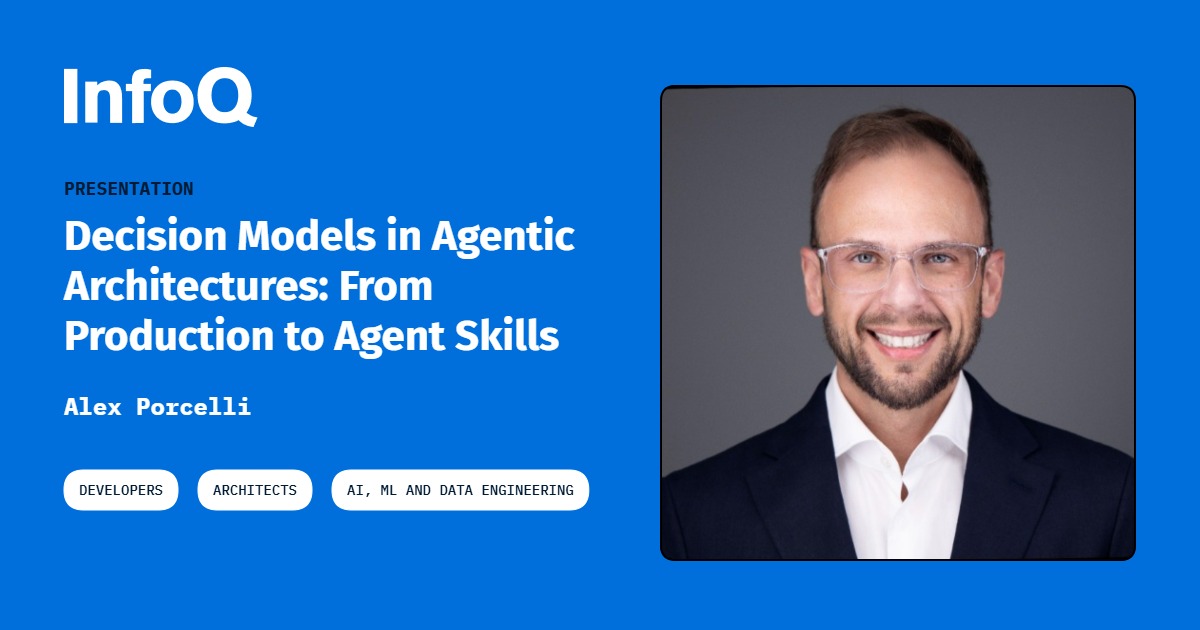
📖 Source: Presentation: Decision Models in Agentic Architectures: From Production to Agent Skills
Related Articles
Comments (0)
No comments yet. Be the first to comment!