
AI Agents Orchestrate Global ClickHouse Infrastructure

Alps Wang
Jul 23, 2026 · 1 views
Agentic Ops: The Future of Infra?
The article compellingly showcases the power of agentic infrastructure management, particularly with a well-designed CLI like clickhousectl. The ability for an AI agent to provision, configure, and manage a distributed ClickHouse stack across three continents with minimal human intervention is a significant leap. The core innovation lies in treating infrastructure as code, scriptable and repeatable by an agent, much like application code. This drastically reduces the complexity and time required for multi-region deployments, democratizing sophisticated cloud operations. The use of remoteSecure() and the Merge engine to create a consolidated global view while respecting data residency is technically elegant and directly addresses a common pain point for distributed applications. The author's emphasis on the CLI's role as the enabler for agentic control is spot-on; a clean, JSON-outputting CLI is crucial for programmatic interaction. This approach has the potential to significantly lower the barrier to entry for managing complex, distributed systems, making it accessible even to smaller teams.
However, several aspects warrant further consideration. While the article highlights the speed and ease of use, it implicitly relies on a robust clickhousectl and a well-understood ClickHouse Cloud API. The security implications of granting API keys to AI agents for infrastructure management are paramount and require rigorous access control and auditing mechanisms, which are only briefly touched upon. Furthermore, the 'agent' here is presented as a sophisticated scripting engine that executes predefined prompts. The article doesn't delve deeply into the agent's decision-making process beyond simple JSON parsing and conditional logic. True agentic capabilities, involving more complex reasoning, self-healing, and adaptive strategies, would require more advanced AI models and integration. The 'demo' nature of the setup, while effective for illustration, might mask the complexities of handling real-world edge cases, network instability, or nuanced compliance requirements that go beyond basic data residency. Scaling this to dozens or hundreds of services and regions would introduce new challenges in state management, idempotency, and conflict resolution that need careful architectural planning.
The primary beneficiaries are DevOps engineers, SREs, and platform engineers who are tasked with building and maintaining distributed systems. This approach offers them a way to automate repetitive and complex tasks, freeing them to focus on higher-level strategic initiatives. Developers could also benefit by gaining more control over their deployed environments without needing deep infrastructure expertise, fostering a more integrated CI/CD pipeline. The technical implications are substantial: it points towards a future where infrastructure management becomes increasingly automated and accessible, potentially blurring the lines between development and operations further. This could lead to more resilient, performant, and cost-effective distributed applications. The comparison to existing solutions is implicitly made by highlighting the limitations of manual click-through consoles; clickhousectl and agentic automation offer a superior alternative for repeatable, scalable deployments.
Key Points
- An AI agent was used to provision and manage a distributed ClickHouse infrastructure across three continents.
- The
clickhousectlCLI tool was instrumental, enabling the agent to interact with ClickHouse Cloud services programmatically. - The solution creates a global observability platform by federating regional ClickHouse instances using
remoteSecure()and theMergeengine. - This approach demonstrates how infrastructure can be treated as code, automatable and repeatable by agents.
- The article highlights the importance of a clean, JSON-outputting CLI for effective agentic infrastructure management.
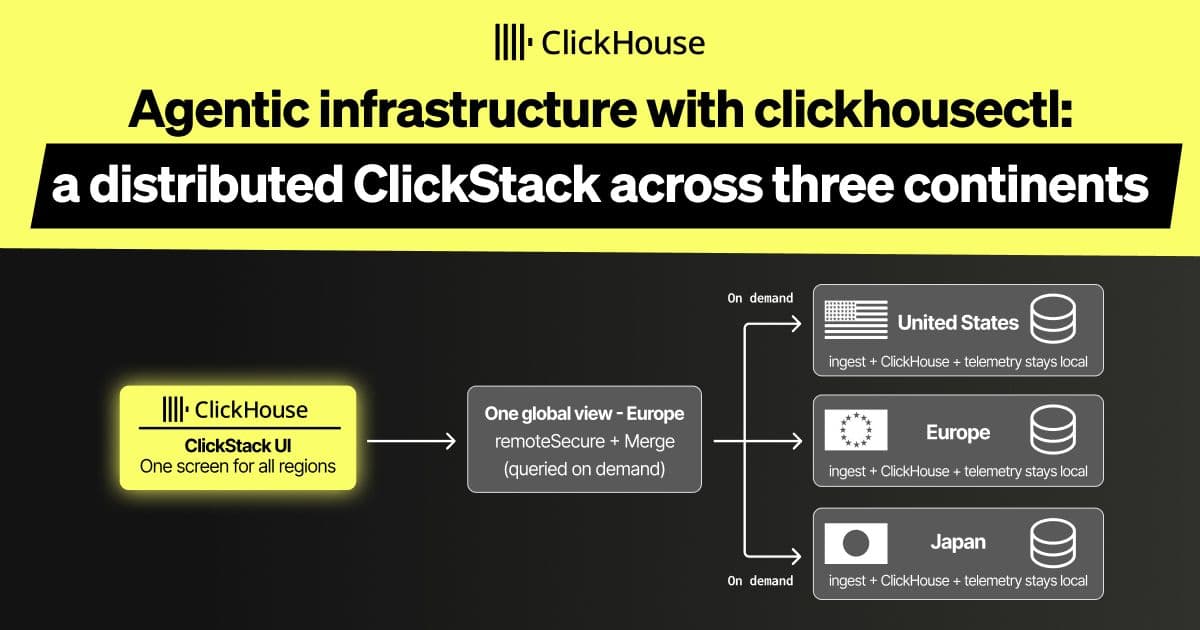
📖 Source: Agentic infrastructure with clickhousectl: a distributed ClickStack across three continents
Related Articles
Comments (0)
No comments yet. Be the first to comment!