
AWS Specs Drive Flexible Data Workflows

Alps Wang
Aug 27, 2026 · 3 views
Decoupling Intent from Execution
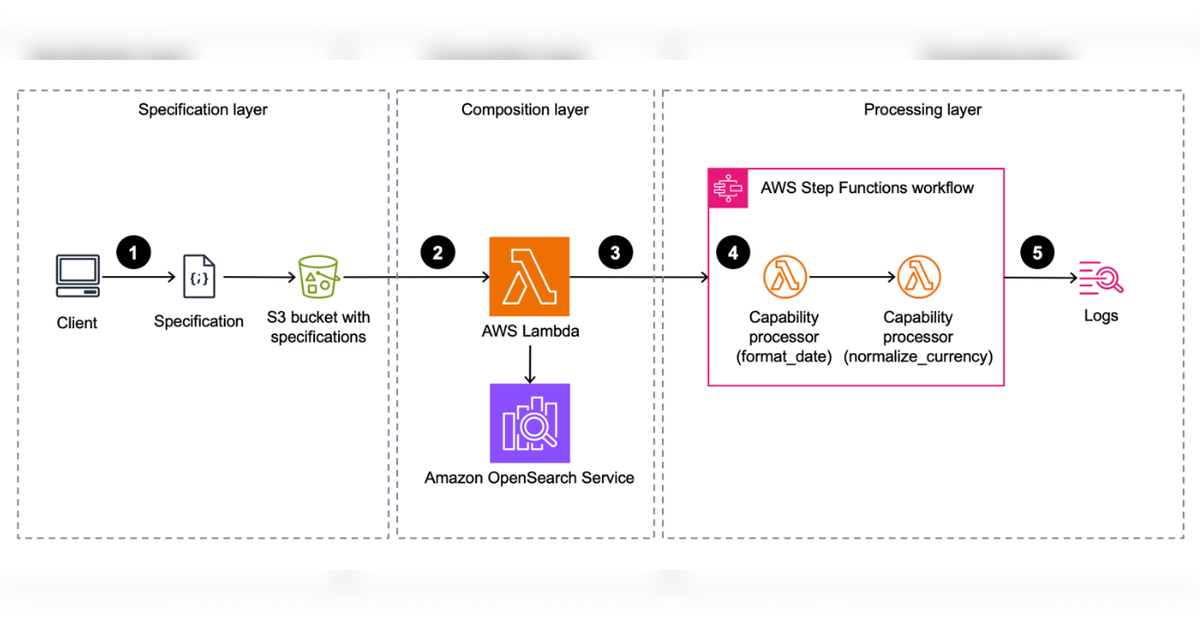
AWS's introduction of specification-driven composition for data workflows represents a sophisticated evolution in managing complex data pipelines. The core innovation lies in its declarative approach, separating the 'what' (the specification) from the 'how' (the execution logic). This separation is crucial for addressing the common pain points of duplicated code, difficult validation, and poor traceability in traditional script-based ETL processes. By codifying workflow intent into structured specifications (JSON/YAML), organizations gain a single source of truth for workflow logic, making it easier to manage, audit, and govern. The three-layer architecture – intent, composition, and processing – provides a robust framework for achieving this decoupling. The serverless implementation leveraging Lambda, Step Functions, S3, and OpenSearch is a smart choice, offering scalability and cost-effectiveness. The ability to reference reusable capabilities by intent rather than implementation details, coupled with versioning, significantly enhances modularity and maintainability. Furthermore, the integration of data classification and masking directly into the specification addresses a critical need in regulated environments.
However, the pattern might introduce a learning curve and initial overhead for teams accustomed to simpler, imperative scripting. The 'unnecessary complexity' for basic workflows, as noted by AWS, is a valid concern. Organizations will need to carefully assess whether the benefits of enhanced governance and flexibility outweigh the added abstraction for their specific use cases. The reliance on a robust capability registry and the need for well-defined, reusable processing components are critical success factors. If these components are not meticulously managed or if the specification language becomes overly complex, the intended benefits could be undermined. The success of this pattern will heavily depend on the maturity of the tooling and the discipline of the development teams in adhering to the defined structure and best practices for capability development and specification authoring. The potential for vendor lock-in with specific AWS services, while inherent in cloud-native solutions, is also a consideration for long-term strategy.
Key Points
- AWS introduces Specification-Driven Composition for building flexible and maintainable data transformation workflows.
- The pattern decouples workflow intent (specification) from processing logic, reducing code duplication and improving traceability.
- It utilizes a three-layer architecture: intent (specification), composition (validation & assembly), and processing (execution).
- Specifications are declarative (JSON/YAML) and describe data sources, targets, mappings, and transformations without implementation details.
- A capability registry stores metadata for reusable transformation functions, enabling discovery and versioning.
- Serverless implementation uses AWS Lambda, Step Functions, S3, and OpenSearch.
- Addresses challenges in regulated environments with integrated data classification and masking.
- Best suited for complex, high-variation workflows with strong governance requirements; may be overly complex for simple tasks.
📖 Source: AWS Introduces Specification Driven Composition for Flexible Data Workflows
Related Articles
Comments (0)
No comments yet. Be the first to comment!