
Beyond Prompts: Mastering Context Engineering

Alps Wang
Apr 7, 2026 · 1 views
The State of AI Context
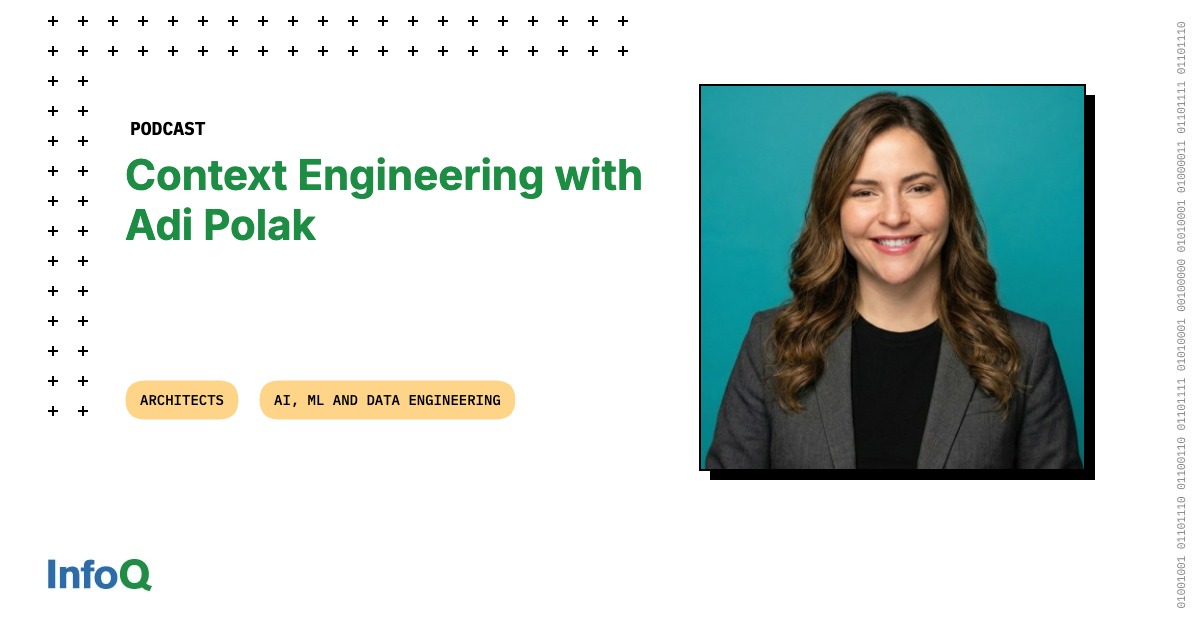
The podcast episode on 'Context Engineering with Adi Polak' offers a compelling argument for the evolution beyond traditional prompt engineering towards more sophisticated, stateful AI systems. A key insight is the diminishing effectiveness of static prompt techniques like role assignment, necessitating a deeper understanding of domain knowledge to craft precise instructions. The discussion highlights how saving successful workflows as reusable 'skills' is crucial for scaling AI adoption and preventing repetitive effort. This shift towards context engineering, particularly when integrated with event-driven patterns for agentic workflows, promises to automate complex tasks, enrich data, and orchestrate multi-step processes with greater accuracy and efficiency. The practical example of using Claude Code to rectify a complex Git commit issue within minutes, a task that would have taken hours of manual effort and context switching for a human, powerfully illustrates the immediate value and potential of these advanced techniques. This transition is not just about better LLM interaction but about building robust, reliable AI-powered applications.
However, while the benefits of context engineering are clear, the practical implementation at scale presents challenges. The article touches upon the need for careful context management – separating long-term knowledge from short-term memory – which implies significant architectural considerations for data storage and retrieval. This raises questions about the underlying infrastructure required to support stateful agentic workflows, particularly concerning latency, cost, and the complexity of managing state across distributed systems. While the podcast mentions tools like Claude Code, the broader ecosystem for building and deploying such context-aware systems is still maturing. Developers will need robust frameworks for defining, storing, and executing these reusable skills, along with effective strategies for debugging and monitoring complex agentic interactions. The article implicitly points to a future where database and data layer design will be intrinsically linked to the success of AI agent development, demanding new patterns for memory, state, and coordination.
Key Points
- Prompt engineering techniques are becoming less effective as LLMs and tooling mature, requiring deeper domain knowledge.
- Context engineering allows AI systems to be stateful, moving beyond the stateless nature of traditional prompting.
- Saving successful workflows as reusable 'skills' is essential for scaling AI adoption and avoiding redundant effort.
- Agentic, stateful workflows built on event-driven patterns are crucial for automating tasks and coordinating multi-step processes.
- Careful context management, separating long-term knowledge from short-term memory, improves accuracy and cost-efficiency.
- The evolution towards context engineering necessitates advancements in data layer design for state, memory, and coordination in agentic AI.
Related Articles
Comments (0)
No comments yet. Be the first to comment!