
ClickHouse's Huge Pages for Postgres Performance

Alps Wang
Jul 15, 2026 · 1 views
Unlocking Postgres Performance with Huge Pages
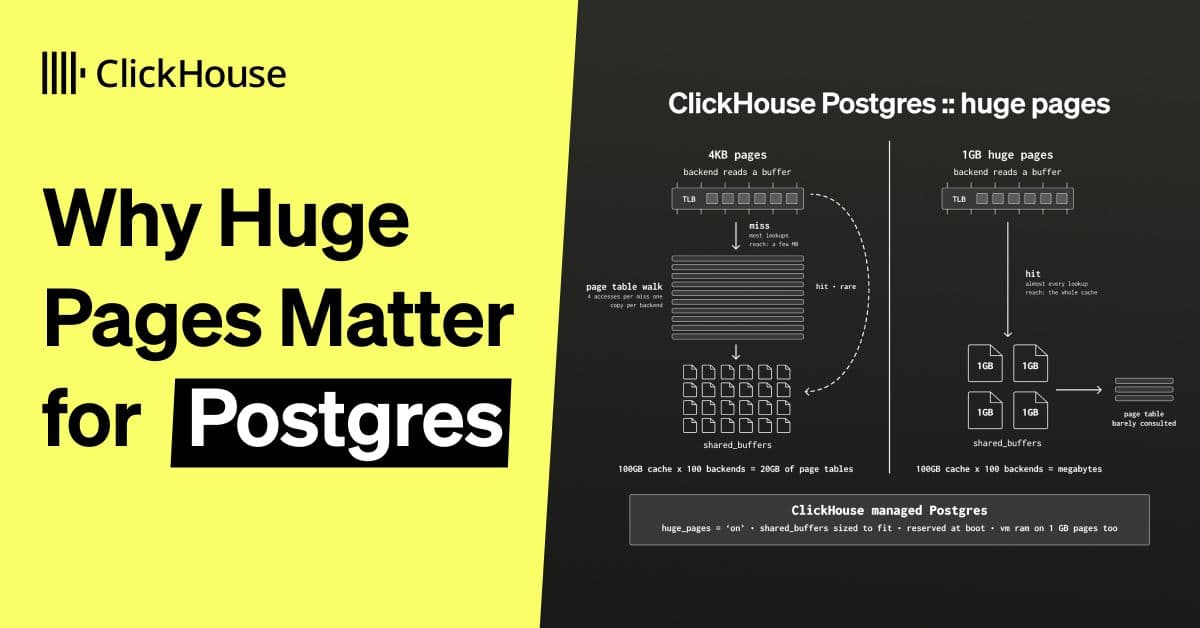
The ClickHouse blog post provides a compelling technical deep-dive into the benefits and implementation of huge pages for PostgreSQL in their managed service. The core insight is the dramatic reduction in page table overhead and TLB misses by using larger memory pages, directly translating to improved performance, especially under high connection loads. The article clearly articulates why Postgres is particularly sensitive to this, due to its shared memory architecture. The three-pronged approach to ensuring huge page reliability – early reservation, mandatory usage, and precise sizing of shared_buffers – is a robust engineering solution that addresses potential pitfalls. The detailed explanation of the sizing calculation, accounting for overhead beyond just shared_buffers, demonstrates a mature understanding of PostgreSQL's memory management.
However, while the article focuses on ClickHouse Managed Postgres, the underlying principles and configuration steps are broadly applicable to any PostgreSQL deployment on Linux. The primary limitation is that achieving this reliably requires root access and careful system administration, which might not be feasible for all users. The article implicitly assumes a controlled environment where memory fragmentation can be managed before huge page reservation. Furthermore, while performance gains are quantified, the exact trade-offs, such as potential increased memory usage if shared_buffers is oversized relative to the actual working set, are not extensively explored. The article could also benefit from a more direct comparison to other memory management techniques or database systems that might handle large shared memory segments differently. Nevertheless, for organizations running high-concurrency PostgreSQL workloads, this article offers invaluable, actionable insights into a critical performance tuning technique.
Key Points
- Using huge pages (2MB or 1GB) instead of default 4KB pages drastically reduces memory overhead from page table entries and improves Translation Lookaside Buffer (TLB) efficiency in PostgreSQL.
- This is particularly beneficial for PostgreSQL's
shared_buffersdue to its large shared memory segment, reducing per-connection page table costs from tens of MB to kilobytes. - ClickHouse Managed Postgres ensures huge page reliability through three key steps: reserving memory early before fragmentation, enforcing
huge_pages = 'on'to fail on startup if not available, and precisely sizingshared_buffersto fit within the reserved pool, accounting for segment overhead. - Practical implementation involves system-level configuration (
sysctl.conf,drop_caches,compact_memory) and careful PostgreSQLshared_bufferscalculation usingpostgres -D -C shared_memory_sizeto determine the exact segment size. - The benefits are demonstrated by reduced page table memory consumption (from GBs to MBs for 200 connections) and a noticeable increase in transaction throughput (around 12% in benchmarks).
📖 Source: How we configure huge pages in ClickHouse Managed Postgres
Related Articles
Comments (0)
No comments yet. Be the first to comment!