
Grab's AI Agents Slash Analyst Workload

Alps Wang
Aug 18, 2026 · 2 views
Agentic Analytics at Grab
Grab's implementation of AI agents to automate analytics workflows is a compelling case study, demonstrating tangible benefits like reduced mechanical task load and faster response times. The five-level autonomy model provides a structured approach to integrating AI into existing processes, balancing automation with necessary human oversight. The emphasis on building a robust 'data context' layer, including certified tables, metrics, and documentation, is crucial for the reliability and scalability of these agents. This investment in data governance and quality is a critical prerequisite often overlooked in AI initiatives.
However, the article hints at the challenges of scaling AI agents, particularly the 'harder question' of what analysts do next. While Grab has reduced mechanical work, the next phase of evolution for these analysts, focusing on deeper interpretation and strategic insight, is a significant organizational and skill-development challenge. The success of this model hinges on continuous investment in both AI capabilities and human upskilling. Furthermore, the article doesn't delve deeply into the specific AI models or architectures underpinning their 'Spartan' and 'ContextIQ' systems, which would be of great interest to a technical audience. The long-term implications for data privacy and security, especially with agents interacting with sensitive business data, also warrant further exploration.
Key Points
- Grab has successfully reduced the share of mechanical analytics tickets handled by analysts from 44% to 30% using AI agents.
- The approach is based on a five-level autonomy model, defining agent capabilities and human oversight.
- Key tasks automated include data preparation, alerting, and reporting.
- Grab emphasizes a strong data context layer (5,000+ certified tables/metrics, 4,000 context docs) with its ContextIQ system.
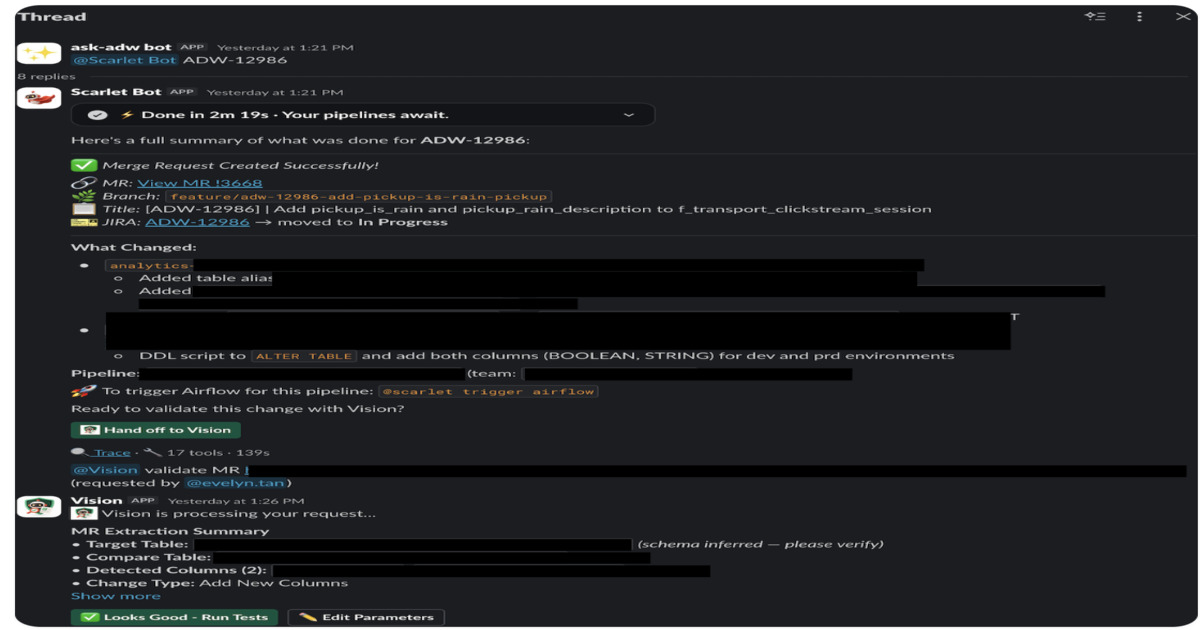
- AI agents are also used for analytics operations, such as root cause analysis of pipeline failures (Scarlet system).
- Recurring analytics, like metric and OKR commentary, are automated.
- Self-service analytics response rates have significantly increased for various request types.
- The shift allows analysts to focus more on self-service workflows and deeper analysis.
📖 Source: Grab Cuts Mechanical Analytics Work From 44% to 30% with AI Agents
Related Articles
Comments (0)
No comments yet. Be the first to comment!