
Stateless MCP: AWS Simplifies AI Agent Scaling

Alps Wang
Sep 25, 2026 · 1 views
Stateless MCP: A Scalability Game-Changer
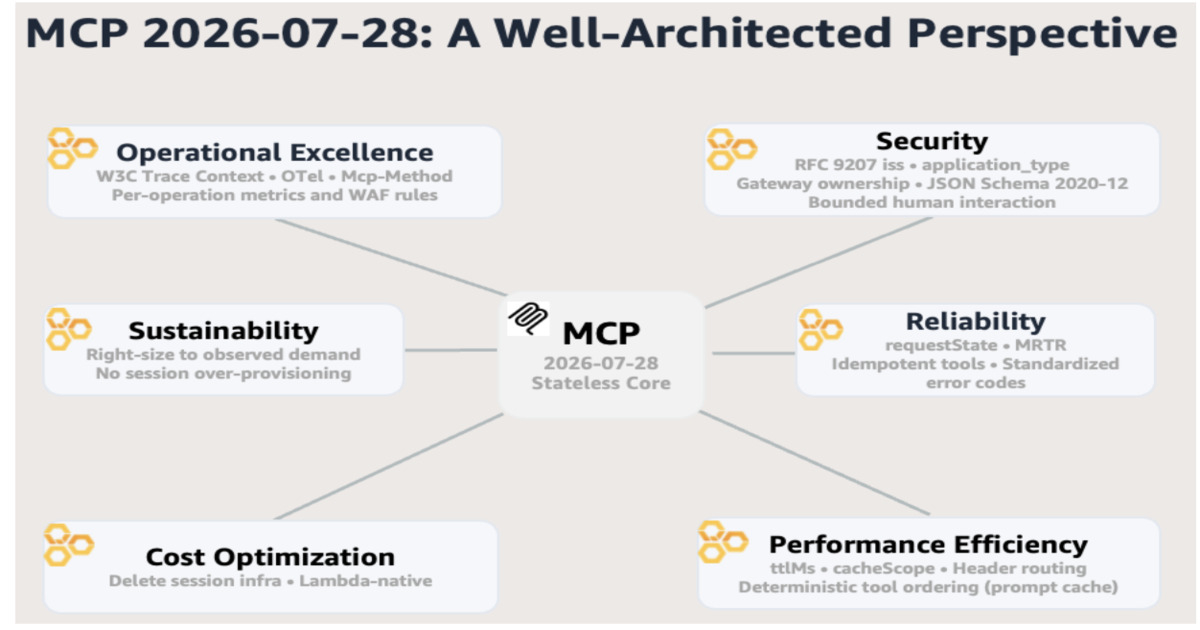
The InfoQ article effectively highlights the core innovation of the stateless MCP specification: the removal of protocol-level session affinity. This directly addresses a significant pain point for developers deploying AI agents on AWS, enabling simpler horizontal scaling and reducing infrastructure overhead associated with maintaining sticky sessions. The shift towards statelessness at the protocol level, while leaving application state management to developers, is a crucial distinction, as succinctly captured by Michael Madsen's quote. This architectural change promises to streamline deployments, particularly for serverless environments like AWS Lambda, which are inherently designed for request-response interactions. The introduction of new headers like Mcp-Method and Mcp-Name for routing and throttling, along with W3C Trace Context support, further enhances the protocol's robustness and observability, aligning it with modern microservices best practices and AWS's Well-Architected framework for agentic AI.
However, the article also prudently points out the transition challenges. The removal of stream resumability necessitates increased attention to idempotency for client-side operations, a critical consideration for distributed systems where failures are inevitable. The need for backward compatibility and a clear migration path, as demonstrated by Apify's dual implementation, underscores the practical complexities of adopting such a fundamental protocol change. AWS's recommendation to track protocol versions at the gateway and retain legacy infrastructure until all traffic is migrated is a sound, albeit potentially resource-intensive, approach. For organizations heavily invested in existing MCP sessionful deployments, this transition will require careful planning and execution to avoid service disruptions. The article could benefit from a deeper dive into potential performance implications of this statelessness, such as increased load on load balancers or potential latency shifts due to the absence of cached session state, although these are likely to be application-dependent and managed by surrounding infrastructure.
Key Points
- The latest Model Context Protocol (MCP) specification has been updated to be stateless at the protocol level.
- This change removes the requirement for session affinity (sticky sessions) and shared session stores for remote MCP server deployments.
- Requests can now be routed independently to any available server instance behind a conventional load balancer.
- This simplification facilitates horizontal scaling and reduces infrastructure overhead.
- AWS Lambda is highlighted as a suitable deployment option due to the protocol's new request-response model.
- New headers (
Mcp-Method,Mcp-Name) are introduced for gateway routing and throttling. - W3C Trace Context support enhances distributed tracing capabilities.
- Stream resumability is removed, increasing the importance of idempotency for tool calls.
- A transition path and migration period are necessary for deployments supporting earlier MCP clients.
📖 Source: Stateless MCP Removes Session Affinity Requirements for AWS Server Deployments
Related Articles
Comments (0)
No comments yet. Be the first to comment!