
Unlock ClickHouse Speed: 10 Essential Best Practices

Alps Wang
Mar 27, 2026 · 1 views
Optimizing ClickHouse for Peak Performance
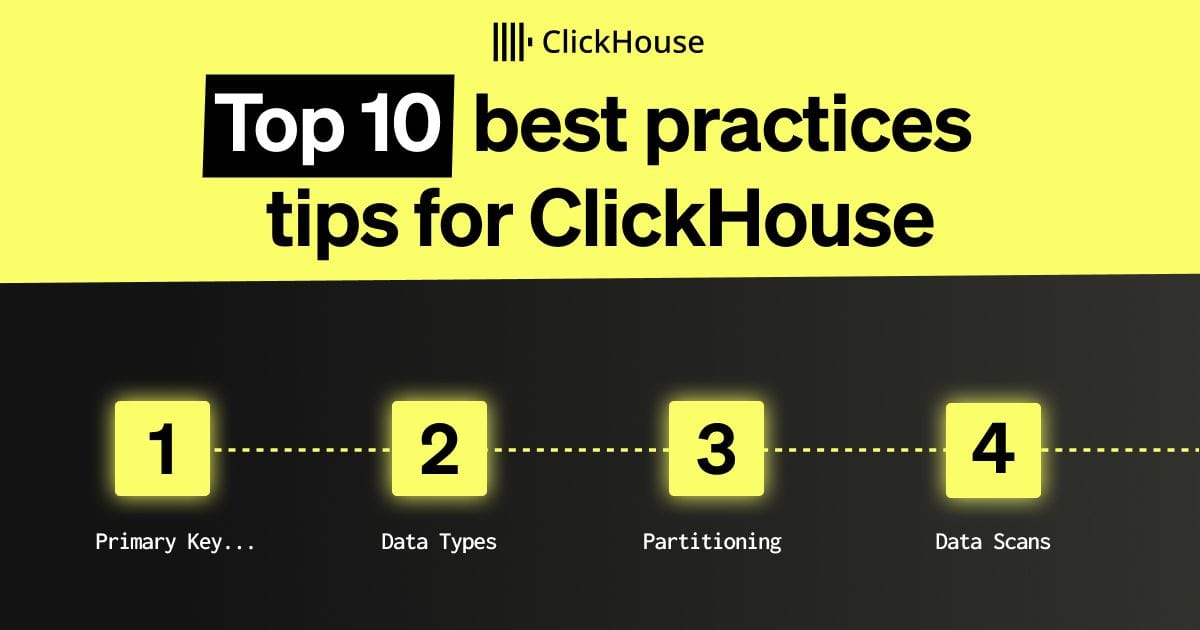
This article provides a highly practical and valuable set of best practices for optimizing ClickHouse performance and efficiency. The author, drawing from hands-on experience, effectively translates complex architectural concepts into concrete, actionable advice. The emphasis on aligning data types, primary keys, and partitioning strategies with actual query patterns is crucial and well-articulated. The use of the Amazon reviews dataset as a consistent example throughout the article greatly aids in illustrating the tangible benefits of each practice, demonstrating order-of-magnitude improvements in speed and storage reduction. The detailed explanation of skipping indexes and the JSON data type, including their nuances and trade-offs, is particularly insightful for users dealing with semi-structured data or complex filtering requirements.
One of the article's strengths lies in demystifying common pitfalls, such as the misuse of partitioning. By clearly explaining its primary role as a data management feature rather than a blanket performance enhancer, the author prevents readers from making costly mistakes. The advice on data ingestion formats, recommending columnar over row-based, is also a critical point for efficient bulk loading. The article is comprehensive, covering schema design, data modeling, query optimization, and ingestion. While the article is exceptionally well-written, it could potentially benefit from a brief mention of the trade-offs associated with each practice in terms of development complexity or ongoing maintenance, though the focus on practical gains largely mitigates this concern. The inclusion of a link to specific guidance for AI agents is a thoughtful addition, acknowledging the evolving use cases of ClickHouse.
Key Points
- Align
ORDER BYclauses with common query patterns, prioritizing low-cardinality columns for efficient primary index pruning and better compression. - Choose the smallest appropriate data types, avoid
Nullableunless necessary, and leverageLowCardinality(String)andEnumfor text and fixed value sets to reduce storage and improve query speed. - Partitioning should be used for data management (e.g., TTL-based expiration) or specific merge-oriented engines, not as a general performance optimization, as over-partitioning can significantly degrade query performance.
- Utilize skipping indexes (e.g.,
minmax,set,bloom_filter) to extend primary index granule-pruning capabilities to non-primary key columns, significantly reducing scanned data. - Leverage ClickHouse's native JSON type for semi-structured data, using hints for predictable paths to improve storage and query performance, but prefer static schemas for fully predictable data.
- Ingest data using columnar formats like Parquet or ORC for bulk loading from object storage, and use ClickPipes for managed, ongoing ingestion from CDC sources and event streams.
Related Articles
Comments (0)
No comments yet. Be the first to comment!