
WAL Backpressure: ClickHouse's Postgres Guardian

Alps Wang
Aug 6, 2026 · 1 views
Proactive WAL Management in Action
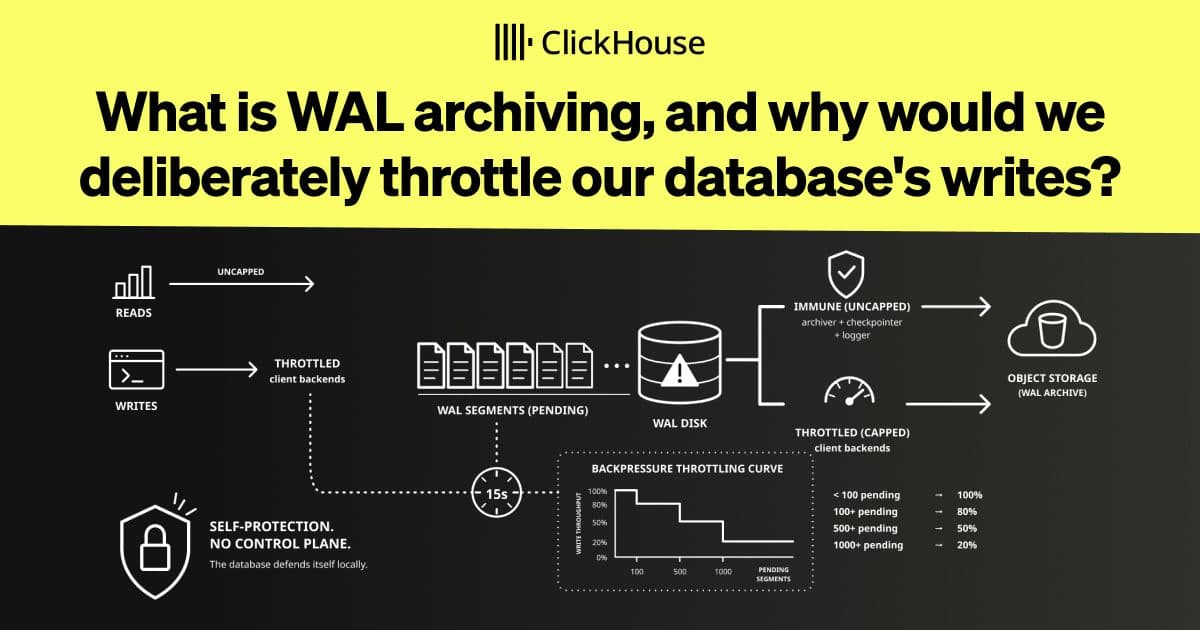
The ClickHouse blog post effectively explains WAL backpressure and its implementation in ClickHouse Managed Postgres, highlighting a crucial mechanism for database stability. The core innovation lies in the intelligent application of cgroup v2 I/O throttling, dynamically adjusting write caps based on the WAL backlog. This proactive approach prevents catastrophic disk fills and instance panics, a common pitfall in high-throughput database environments. The detailed explanation of how the system differentiates between critical drain paths (archiver, checkpointer) and client writes, ensuring the former remain unthrottled, is particularly impressive. This granular control within the data plane, independent of the control plane, significantly boosts resilience.
However, a potential limitation or area for further exploration could be the precise impact of the throttle on different types of workloads. While the article acknowledges that workloads with more WAL-generated bytes per transaction will be more affected, a deeper dive into the trade-offs for various write patterns (e.g., small, frequent updates vs. large batch inserts) might be beneficial. Additionally, while the article states the throttle is a 'day-1 decision' for ClickHouse Managed Postgres, the specific configuration parameters and tuning options available to users (if any) would be valuable information for advanced users. The current implementation appears to be a fixed, production-ready system, which is excellent for ease of use, but flexibility can sometimes be a double-edged sword.
Despite these minor points, the solution presented is a strong testament to ClickHouse's engineering prowess in managing complex database operations. It directly benefits any user of ClickHouse Managed Postgres by ensuring higher availability and preventing data loss due to WAL disk exhaustion. Developers and database administrators who have experienced or worried about similar issues in other managed PostgreSQL offerings will find this feature particularly compelling. The technical depth, coupled with a clear demonstration of its effectiveness through a simulated scenario, makes this a highly informative and impactful article.
Key Points
- WAL archiving is crucial for point-in-time recovery, but can lead to disk full panics if writes outpace archiving.
- ClickHouse Managed Postgres implements WAL backpressure using cgroup v2 I/O throttling.
- The system dynamically caps write bandwidth based on the WAL segment backlog, tightening caps as the backlog grows.
- Critical database processes (archiver, checkpointer) are excluded from throttling, ensuring the drain path remains unimpeded.
- Reads are never throttled.
- The mechanism is self-contained within the data plane, offering resilience even if the control plane is unavailable.
- A detailed simulation demonstrates the effectiveness of the throttle in preventing disk exhaustion and maintaining database availability.
📖 Source: What is WAL backpressure, and why does ClickHouse Managed Postgres need it?
Related Articles
Comments (0)
No comments yet. Be the first to comment!