
ClickHouse Pipelined SQL: Write Queries Like Code

Alps Wang
Sep 4, 2026 · 1 views
Pipelined SQL: A New Paradigm
The introduction of pipelined SQL in ClickHouse 26.8 represents a compelling step forward in query authoring, particularly for complex, multi-stage operations. The |> operator's ability to transform SQL from a declarative, column-centric syntax to a more procedural, transformation-oriented flow is a significant improvement for developer ergonomics. This paradigm shift aligns with how developers often conceptualize data processing pipelines, moving from data source identification to sequential filtering, aggregation, and transformation. The EXPLAIN SYNTAX feature elegantly demonstrates how these pipelines are translated into standard SQL, reassuring users that performance is not sacrificed for readability, as ClickHouse optimizes the generated nested queries. The EXTEND keyword further enhances this by allowing calculated columns to be seamlessly integrated without resorting to subqueries, maintaining the pipeline's clarity. This feature is particularly valuable for users who struggle with the verbosity of nested subqueries or CTEs when building intricate analytical queries. The ability to use pipelined SQL within views and INSERT statements also broadens its applicability, making it a versatile addition to the ClickHouse ecosystem.
However, while the benefits of increased readability and ease of development are clear, there are potential limitations and concerns to consider. The primary concern is the learning curve associated with adopting a new syntax. Although |> is intuitive, it represents a departure from traditional SQL, and widespread adoption will depend on how quickly developers embrace it and how well it integrates with existing tooling and IDEs. Furthermore, while the article states that ClickHouse doesn't materialize intermediate results, the EXPLAIN SYNTAX output shows a series of nested SELECT statements. While ClickHouse's optimizer is sophisticated, the complexity of these generated queries could, in some edge cases, lead to unforeseen performance characteristics or debugging challenges compared to a more straightforward, albeit more verbose, conventional SQL. The article also highlights that stage order matters, which is crucial for understanding and correctly implementing pipelines, but could also be a source of errors for those not fully grasping the sequential nature. Ultimately, the success of pipelined SQL will be measured by its adoption rate and its ability to genuinely simplify complex query writing without introducing new performance pitfalls.
Key Points
- ClickHouse 26.8 introduces Pipelined SQL using the
|>operator for a more sequential, transformation-based query writing experience. - This new syntax allows queries to be expressed as a series of explicit steps, improving readability and ease of development for complex operations.
- The
EXTENDkeyword enables the addition of calculated columns within the pipeline without requiring subqueries or CTEs. - Pipelined SQL translates into standard SQL before execution, with ClickHouse optimizing the generated nested queries for performance.
- The syntax can be used in various contexts, including subqueries, INSERT statements, and view definitions.
- Stage order in pipelines is critical and affects the intermediate results, impacting the final outcome.
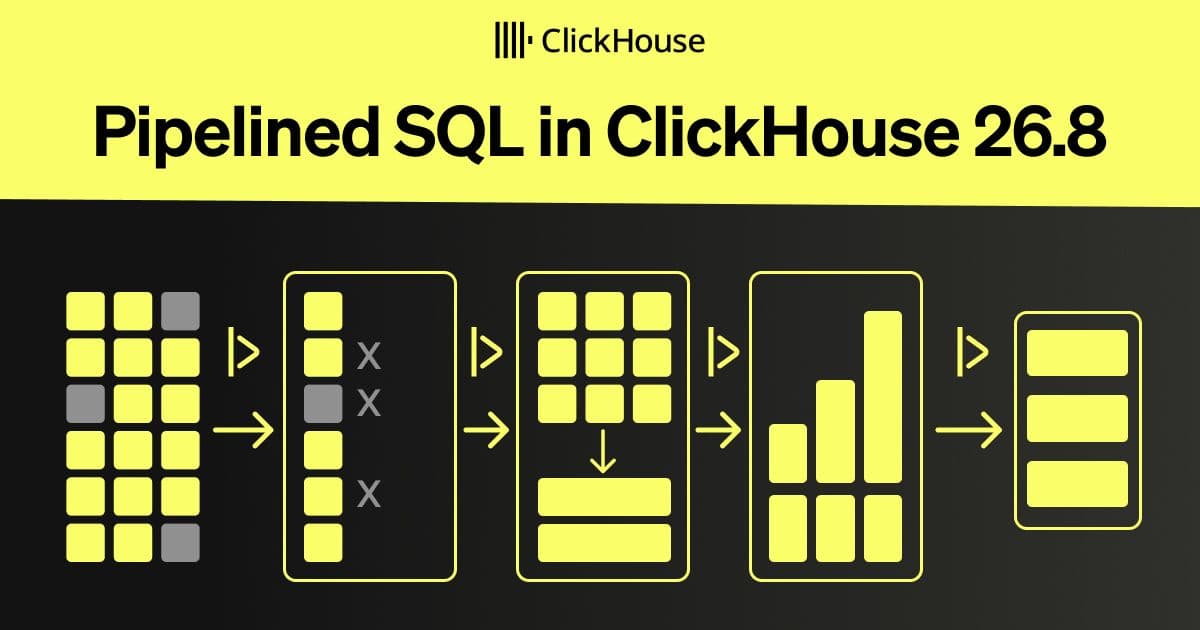
📖 Source: Pipelined SQL in ClickHouse 26.8
Related Articles
Comments (0)
No comments yet. Be the first to comment!