
Meta's ZGateway: 1B+ Ops/Sec, 19x Fewer Connections

Alps Wang
Sep 28, 2026 · 1 views
Architecting for Hyperscale
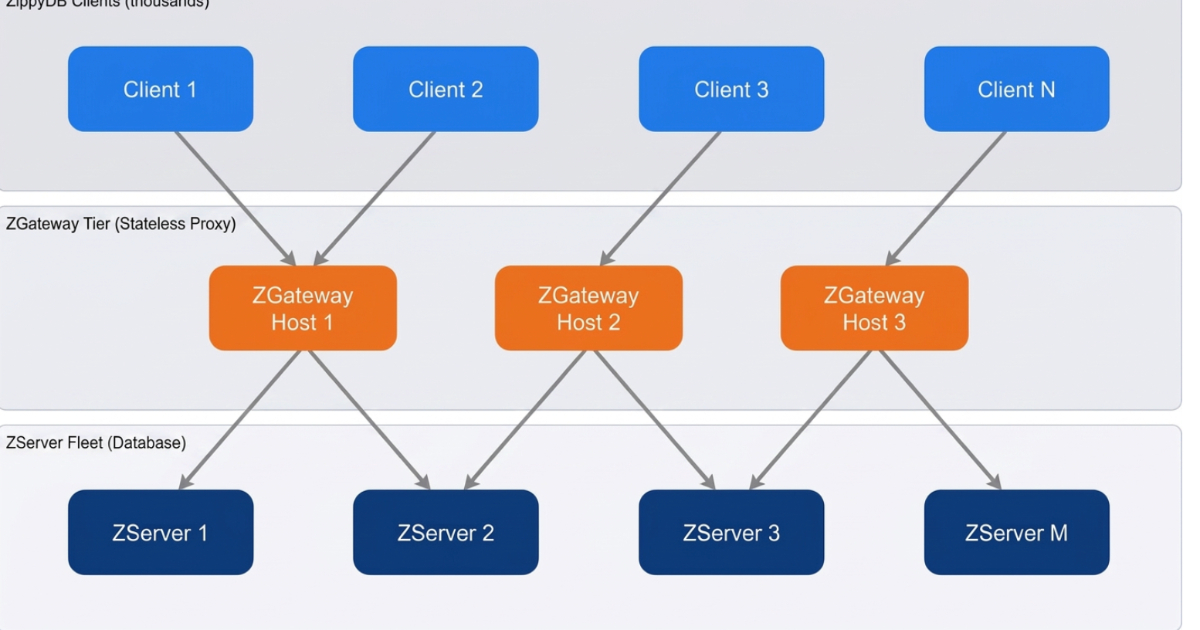
Meta's ZGateway represents a sophisticated solution to a pervasive challenge in distributed systems: managing an overwhelming number of client connections to a high-throughput key-value store like ZippyDB. The core innovation lies in introducing a stateless proxy layer that aggregates client requests, thereby drastically reducing the direct connection burden on the database shards. This architectural shift is crucial for organizations operating at hyperscale, where the direct many-to-many connection mesh between millions of clients and hundreds of thousands of database hosts can lead to critical resource exhaustion issues like file descriptor limits and out-of-memory errors. The reported 19x reduction in persistent connections, translating to a 97-98% per-host connection count decrease, is a testament to the effectiveness of this approach. Furthermore, ZGateway's ability to perform traffic management functions such as authentication, authorization, admission control, shard resolution, local caching, and request coalescing at the proxy tier before forwarding to ZServer replicas is a significant enhancement. This not only offloads work from the database nodes but also enables more intelligent and centralized control over traffic flow, leading to improved overall system stability and potentially lower latency, as suggested by the observation that freeing database nodes from connection management overhead can improve performance.
The implications for Meta are substantial, enabling ZippyDB to continue scaling and serving critical workloads like product metadata and configuration across their global infrastructure. For other large tech companies or organizations facing similar connection management challenges with their distributed databases, ZGateway offers a compelling blueprint. The integration with Meta's existing ServiceRouter for discovery and the utilization of their C++ ZippyDB client as the request engine highlight a pragmatic approach to leveraging existing infrastructure. The planned future enhancements, including agent-operated controls and selective co-location, suggest a continuous evolution towards greater efficiency and resilience. However, the introduction of an additional network hop, while beneficial for connection management, is a deliberate trade-off that warrants careful monitoring of latency in specific use cases. The success of ZGateway hinges on its ability to maintain low latency and high availability, especially during peak loads and potential failure scenarios within the gateway tier itself. The controlled tests demonstrating resilience above 90% CPU usage are encouraging, but ongoing performance tuning and robust failure detection mechanisms within ZGateway will be critical for its widespread adoption and continued success.
Key Points
- Meta introduced ZGateway, a stateless proxy layer for its distributed key-value store, ZippyDB.
- ZGateway addresses connection and reliability challenges caused by over one million client hosts.
- The architecture significantly reduces persistent connections by approximately 19x, and per-host connections by 97-98%.
- It handles over 1 billion operations per second, managing about 40% of ZippyDB traffic.
- ZGateway performs centralized traffic management, including authentication, authorization, caching, and request coalescing.
- This offloads connection management overhead from ZippyDB servers, potentially improving latency.
- The solution integrates with Meta's ServiceRouter for discovery and leverages existing ZippyDB client code.
📖 Source: Meta’s ZGateway Cuts ZippyDB Connections 19x While Handling 1B+ Operations per Second
Related Articles
Comments (0)
No comments yet. Be the first to comment!