
Postgres HA: Performance Cost Revealed

Alps Wang
Jul 22, 2026 · 2 views
HA Performance Trade-offs Unpacked
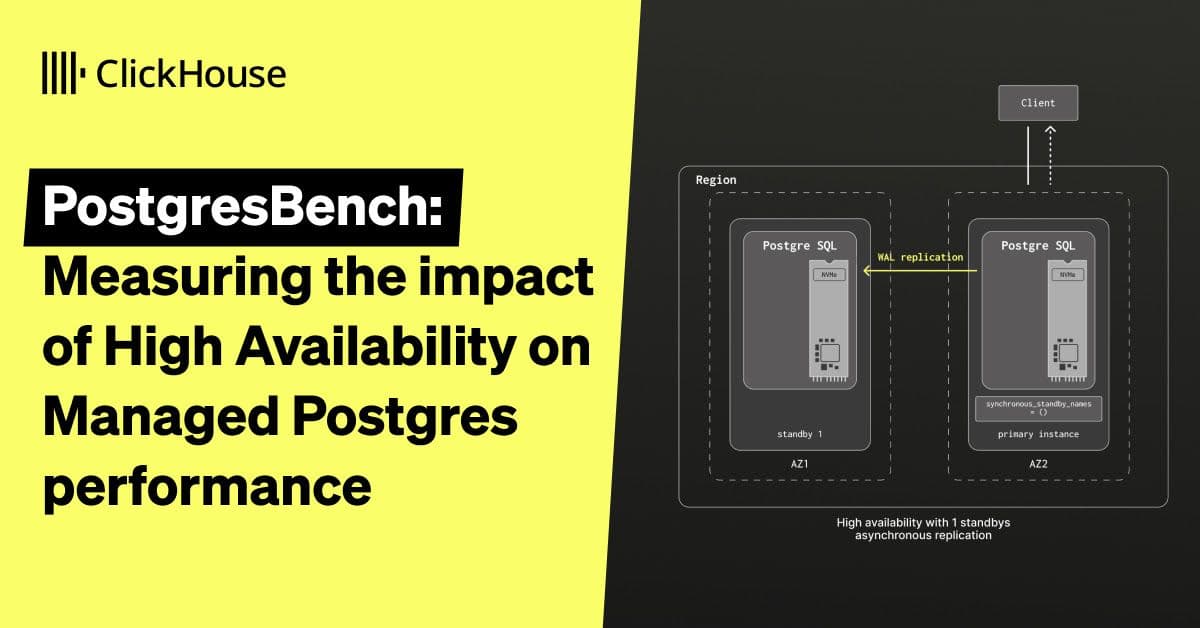
The ClickHouse blog post, 'PostgresBench: Measuring the impact of High Availability on Managed Postgres performance,' offers a valuable and transparent benchmark for managed PostgreSQL services, specifically focusing on the performance implications of High Availability (HA) configurations. The key insight is that achieving zero data loss (RPO=0) and fast recovery (RTO within 2 minutes) comes with a measurable performance penalty, which varies significantly across different managed providers and their underlying architectural choices (shared-nothing vs. shared-storage). The benchmark's strength lies in its reproducibility and the clear methodology outlined, allowing users to understand the tangible impact of HA on TPS and latency. The comparison between ClickHouse Managed Postgres and competitors like AWS RDS, Aurora, and Neon is particularly insightful, showcasing substantial performance advantages for ClickHouse in scenarios demanding high durability.
However, a significant limitation is that this benchmark measures only the performance cost of HA, not a comprehensive HA solution comparison. While transparency is a strength, the article acknowledges that shared-storage services (Aurora, Neon) have undisclosed storage backend configurations that influence performance and reliability, making a direct apples-to-apples comparison challenging. Furthermore, the benchmark is limited to specific instance and dataset sizes, and a fixed 10-minute duration. While the authors plan to expand PostgresBench with more providers, workloads, and configuration options, the current scope might not cover all production use cases. The article also subtly highlights potential concerns with Neon's HA claims, referencing reliability issues, which, while framed within the benchmark's scope, could raise questions for potential users.
The technical implications are substantial for anyone selecting a managed PostgreSQL service for critical applications. Developers and database administrators can use these results to make more informed decisions, balancing the need for data durability and availability against performance requirements and cost. The detailed breakdown of TPS and p99 latency differences between HA configurations and single-node deployments provides concrete data points for capacity planning and performance tuning. The distinction between shared-nothing and shared-storage architectures is crucial, as it explains the fundamental differences in how HA is achieved and its resulting performance characteristics. For instance, the synchronous replication in RDS Multi-AZ incurs a higher latency penalty compared to ClickHouse's approach, and Aurora/Neon's shared storage offers a different set of trade-offs. The article also encourages community contribution, which is a positive sign for the evolution of PostgresBench into a more comprehensive industry standard.
Key Points
- The benchmark measures the performance cost of High Availability (HA) configurations in managed PostgreSQL services.
- Achieving zero data loss (RPO=0) and fast recovery (RTO < 2 min) incurs a performance penalty, varying by vendor and architecture.
- Shared-nothing architectures (e.g., ClickHouse, RDS) rely on native replication with standbys, while shared-storage (e.g., Aurora, Neon) separates compute and storage.
- ClickHouse Managed Postgres demonstrated significant performance advantages (higher TPS, lower latency) across various HA configurations compared to competitors like RDS, Aurora, and Neon.
- The benchmark's transparency and reproducibility are key strengths, empowering users to make informed decisions.
- Limitations include focusing solely on performance cost and the undisclosed storage backend details for shared-storage services.
- Future plans for PostgresBench include adding more providers, workloads, and configurable parameters.
📖 Source: PostgresBench: Measuring the impact of High Availability on Managed Postgres performance
Related Articles
Comments (0)
No comments yet. Be the first to comment!